Tuesday, November 4, 2025

Hints/links or Solutions to 2014 Harder Mathcounts State Sprint and Target question

Links, notes, Hints or/and solutions to 2014 Mathcounts state harder problems.
2014, 2015 Mathcounts state are harder 

Sprint round:

#14 :
Solution I :
(7 + 8 + 9)  + (x + y + z)  is divisible by 9, so the sum of the three variables could be 3, 12, or 21.
789120 (sum of 3 for the last three digits) works for 8 but not for 7.
21 is too big to distribute among x, y and z (all numbers are district),
thus only x + y + z = 12 works and z is an even number
__ __ 0 does't work (can't have 6 6 0 and the other pairs all have 7, 8 or 9)
264 works (789264 is the number)

Solution II : 
789000 divided by the LCM of 7, 8 and 9, which is 504 = 1565.47...
Try 504 * 1566 = 789264 (it works)
The answer is 264.

#18:
Watch this video from Mathcounts mini and use the same method for the first question,
you'll be able to get the answer. It's still tricky, though.

#23 : Drop the heights of the two isosceles triangles and use similar triangles to get the length of FC.
Then solve.

#24: 
The key is to see 210 is 1024 or about 103

230 = ( 210 ) or about (103  )3about 109 so the answer is 10 digit.

#25:
As you can see, there are two Pythagorean Triples : 9-12-15 and 9-40-41.
Base (40-12) = 28 gives you the smallest area.
The answer is 28 * 18 = 504


#26 : Let there be A, B, C three winners. There are 4 cases to distribute the prizes.
A     B    C
1      1     5    There are 7C1 * 6C1 * \( \dfrac {3!} {2!}\) = 126 ways -- [you can skip the last part for C
because it's 5C5 = 1]

1       2    4    There are 7C1* 6C2 * 3! = 630

1      3     3    There are 7C1 * 6C3 * \( \dfrac {3!} {2!}\) = 420

2      2    3     There are 7C2 * 5C2 * 3 (same as above)

Add them up and the answer is 1806.

If you can't see why it's \( \dfrac {3!} {2!}\) when there is one repeat, try using easier case to help you understand.

What about A, B two winners and 4 prizes ?
There are 2 cases, 1 3 or 2 2, and you'll see how it's done.

#27 : Read this and you'll be able to solve this question at ease, just be careful with the sign change.
Vieta's Formula and the Identity Theory

#28: There are various methods to solve this question.
I use binomial expansion :
\(11^{12}=\left( 13-2\right)^{12}=12C0*13^{12}\)+ \(12C1*13^{11}*2^{1}\)+... \(12C11*13^{1}*2^{11}\)+ \(12C12*2^{12}\) Most of the terms will be evenly divided by 13 except the last term, which is \(2^{12}\) or 4096, which, when divided by 13, leaves a remainder of 1.

Solution II :
\(11\equiv -2\left ( mod13\right)\) ; \((-2)^{12}\equiv 4096\equiv 1\left ( mod13\right)\)

Solution III :  
Or use Fermat's Little Theorem (Thanks, Spencer !!)
\(11^{13-1}\equiv 11^{12}\equiv1 (mod 13)\)

Target Round : 

#3: Lune of Hippocrates : in seconds solved question.
^__^

#6: This question is very similar to this Mathcounts Mini.
My students should get a virtual bump if they got this question wrong.

#8: Solution I : by TMM (Thanks a bunch !!)
Using similar triangles and Pythagorean Theorem.

The height of the cone, which can be found usinthe Pythagorean  is $\sqrt{10^2-5^2}=5\sqrt{3}$. 
Usingthediagram below, let $r$ be the radius of the top cone and let $h$ be the height of the topcone. 
Let $s=\sqrt{r^2+h^2}$ be the slant height of the top cone.

//cdn.artofproblemsolving.com/images/ad1f21b9f50ef27201faea84feca6f2e6e305786.png

Drawing the radius as shown in the diagram, we have two right triangles. Since the bases of the top cone and the original cone are parallel, the two right triangles are similar. So we have the proportion\[\dfrac{r}{5}=\dfrac{s}{10}=\dfrac{\sqrt{r^2+h^2}}{10}.\]Cross multiplying yields \[10r=5\sqrt{r^2+h^2}\implies 100r^2=25r^2+25h^2\implies 75r^2=25h^2\implies 3r^2=h^2\implies h=r\sqrt{3}.\]This is what we need.

Next, the volume of the original cone is simply $\dfrac{\pi\times 25\times 5\sqrt{3}}{3}=\dfrac{125\sqrt{3}}{3}$. 

The volume of the top cone is $\dfrac{\pi\times r^2h}{3}$.
From the given information, we know that \[\dfrac{125\sqrt{3}}{3}-\dfrac{\pi\times r^2h}{3}=\dfrac{125\sqrt{3}}{9}\implies 125\sqrt{3}-r^2h=\dfrac{125\sqrt{3}}{3}\implies r^2h=\dfrac{250\sqrt{3}}{3}.\]We simply substitute the value of $h=r\sqrt{3}$ from above to yield \[r^3\sqrt{3}=\dfrac{250\sqrt{3}}{3}\implies r=\sqrt[3]{\frac{250}{3}}.\]We will leave it as is for now so the decimals don't get messy.

We get $h=r\sqrt{3}\approx 7.56543$ and $s=\sqrt{r^2+h^2}\approx 8.7358$.


The lateral surface area of the frustum is equal to the lateral surface area of the original cone minus the lateral surface area of the top cone. The surface area of the original cone is simply 
$5\times 10\times \pi=50\pi$. 
The surface area of the top cone is $\pi\times r\times s\approx 119.874$. 
So our lateral surface area is 

All we have left is to add the two bases. The total area of thebases is $25\pi+\pi\cdot r^2\approx 138.477$. So our final answer is \[37.207+138.477=175.684\approx\boxed{176}.\]
Solution II 
Using dimensional change and ratio, proportion.

Cut the cone and observe the shape.

The circumference of the larger circle is 20pi (10 is the radius) and the base of

the cone circle circumference is 10pi (5 is the radius), which means that the cut-off cone shape is a half circle because it's \(\dfrac {10\pi } {20\pi }\) or \(\dfrac {1 } {2 }\) of the larger circle. (180 degrees)

To find the part that is the area of the frustum not including the top and bottom circles,

you use the area of the half circle minus the area of the smaller half circle.

Since the volume ratio of the smaller cone to larger cone = 2 to 3, the side ratio of the

two radius is \(\dfrac {\sqrt [3] {2}} {\sqrt [3] {3}}\).

Using this ratio, we can get the radius of the smaller circle as 10 * \(\dfrac {\sqrt [3] {2}} {\sqrt [3] {3}}\) and the radius of the top circle of the frustum as 5 * \(\dfrac {\sqrt [3] {2}} {\sqrt [3] {3}}\).


Now we can solve this :

 \(\dfrac {1 } {2 }\)\(\left[ 10^{2}\pi -\left( 10\times \dfrac {\sqrt [3] {2}} {\sqrt [3] {3}}\right) ^{2}\pi \right] \) + \(5^{2}\pi +\left( 5\times \dfrac {\sqrt [3] {2}} {\sqrt {3}}\right) ^{2}\pi \) = about 176 (after you round up)ional change and ratio, proportion.

Cut the cone and observe the shape.

The circumference of the larger circle is 20pi (10 is the radius) and the base of

the cone circle circumference is 10pi (5 is the radius), which means that the cut-off cone shape is a half circle because it's \(\dfrac {10\pi } {20\pi }\) or \(\dfrac {1 } {2 }\) of the larger circle. (180 degrees)

To find the part that is the area of the frustum not including the top and bottom circles,

you use the area of the half circle minus the area of the smaller half circle.

Since the volume ratio of the smaller cone to larger cone = 2 to 3, the side ratio of the

two radius is \(\dfrac {\sqrt [3] {2}} {\sqrt [3] {3}}\).

Using this ratio, we can get the radius of the smaller circle as 10 * \(\dfrac {\sqrt [3] {2}} {\sqrt [3] {3}}\) and the radius of the top circle of the frustum as 5 * \(\dfrac {\sqrt [3] {2}} {\sqrt [3] {3}}\).


Now we can solve this :

 \(\dfrac {1 } {2 }\)\(\left[ 10^{2}\pi -\left( 10\times \dfrac {\sqrt [3] {2}} {\sqrt [3] {3}}\right) ^{2}\pi \right] \) + \(5^{2}\pi +\left( 5\times \dfrac {\sqrt [3] {2}} {\sqrt {3}}\right) ^{2}\pi \) = about 176 (after you round up)


Solution III : Another way to find the surface area of the Frustum is : 
median of the two half circle [same as median of the two bases] * the height [difference of the two radius]
\(\dfrac {1} {2}\left( 2\times 10\pi + 2\times 10\times \dfrac {\sqrt [3] {2}} {\sqrt [3] {3}}\pi \right)\)* \(\left( 10-10\times \dfrac {\sqrt [3] {2}} {\sqrt [3]{3}}\right)\)


Monday, October 27, 2025

2023 Mathcounts school sprint more challenging questions -- Thanks to Ani for trying these problems.

#24 – Probability (Unfair Coin)

Gloria has an unfair coin. Let \( p \) be the probability of heads, with \( \tfrac{1}{2} < p < 1 \). When the coin is flipped three times, the probability of getting exactly two heads is twice the probability of getting exactly two tails. Find the probability of tails when the coin is flipped.

Show Solution
Let \( q = 1 - p \).

\[ P(\text{2 heads}) = 3p^2q, \quad P(\text{2 tails}) = 3q^2p. \] Given \( 3p^2q = 2(3q^2p) \Rightarrow p^2q = 2q^2p. \)
Divide by \( pq \) (nonzero) → \( p = 2q \).

Then \(q = 1-2q \)
Hence \( q = = \boxed{\tfrac{1}{3}}. \)

#26 – Expected Value (Sum of Cubes)

Johnny rolls a fair six-sided die six times and sums the cubes of all results. What is the expected value of this total?

Show Solution
Let \( X_i \) be the result of the \( i^\text{th} \) roll. We want \( E[T] = E[X_1^3 + X_2^3 + \cdots + X_6^3] \).

By linearity of expectation: \[ E[T] = 6 \, E[X^3]. \]
\[ \displaystyle E[X^3] = \frac{1^3+2^3+3^3+4^3+5^3+6^3}{6} \]
\[ = \frac{(1+2+3+4+5+6)^2}{6} = \frac{21^2}{6} = \frac{441}{6} = 73.5. \] Therefore E[T] = 6 times 73.5 = 441 -- the answer.
(This uses the identity \( \sum_{k=1}^{n} k^3 = \big(\sum_{k=1}^{n} k\big)^2 \).)

#30 – Powers and Estimation

Find the integer \( n \) such that \[ n^7 = 44{,}231{,}334{,}895{,}529. \]

Show Solution
Since \(80^7 \approx 2.1\times10^{13}\) and \(90^7 \approx 4.78\times10^{13}\), \(n\) is between 80 and 90. The last digit of \(n^7\) matches the last digit of \(n\), which is 9. Modulo-9 check also gives \(n \equiv 8 \pmod9\), so the only candidate is \(n=89\).

Indeed, \(89^7 = 44{,}231{,}334{,}895{,}529\). Thus \(n = \boxed{89}.\)

Thursday, October 23, 2025

2021 spring AMC 12 B Reflection Notes from H

✅ Correct: 1–21

❌ Wrong / Unanswered:
#22 – Not sure of optimal strategy
#23 – I got stuck with cases
#24–25 – Didn’t attempt

Tuesday, October 21, 2025

2021 spring AMC 12 A Reflection Notes from H

2021 Spring AMC 12A — Reflection Notes

1–16 right, 15 time sink.
18, 19, 23 also right — review #19 solution.

Incorrect / Unanswered:
17, 20, 21, 22

#24, #25 → did not even look at (during the test)

At our lesson, we talked about solutions on all wrong, left blank except #25.

Saturday, October 11, 2025

2016 AMC 12 B Reflection Notes from H

Student Reflection

Wrong

#20

  • no idea how to approach

#23

  • Right approach
  • 2 step away from right answer
  • right answer → understood

#24

  • review using video

#25

  • tried to solve
  • I liked linear recurrence / characteristic polynomial approach

Tuesday, October 7, 2025

2025 Mathcounts state more interested questions notes

target #4 : level 1.5 question, not hard at all. 

#5: number theory, learn mod or remainder (pattern) 

# 6 and #8 Good for AMC/ AIME preps as well. 

team notes : 

 #1: easy, just one line 

#2: symmetry and infinite geometric sequence

#3: mental math 

#4: more tedious, remainders (take more time) 

#5: there is a very fast method 

#6: elementary 

#7: use balanced method (similar to mass point) easy to make sillies if your answer is 82, not "84". CAREFUL ! ! 

 #8 : two methods 

#9 : You need to practice and see if you can solve it at a
timely manner, even if you have the right idea (for AMC
as well) 

 #10: more ambiguous question, harder to tell if you are "Really" right.

Thursday, October 2, 2025

2016 AMC 12 A Reflection Notes from H

2016 AMC 12A Log

✅ Correct

Problems 1 → 23

❌ Wrong

Problems 24, 25

  • Problem 24: Had the right idea but didn’t continue far enough.
  • Problem 25: Didn’t understand the problem even after a video.
📘 Embedded Problems

Problem 24 (paraphrase)

There is a smallest positive real number a such that one can choose a positive real b making all roots of the cubic \(x^3 - a x^2 + b x - a\) real. For this minimal a, the corresponding b is unique. What is that value of b?

Problem 25 (paraphrase)

Let k be a positive integer. Bernardo writes perfect squares starting with the smallest having k + 1 digits; after each square, Silvia erases the last k digits of it. They continue until the final two numbers left on the board differ by at least 2. Let f(k) be the smallest positive integer that never appears on the board. Find the sum of the digits of \(f(2)+f(4)+f(6)+\cdots+f(2016)\).

Note from Mrs. Lin :  To understand this question more in details, try 

this video, starting at 24: 11. 

Saturday, September 13, 2025

2017 AMC 12 B Reflection Notes from H

2017 AMC 12B — Practice Log

Quick reflections and timing notes.
Q1–Q23: all correct ✅ Q22: time sink ⏳ Q24–Q25: not answered ❌

Notable Questions

  • #13: Took me a while; need to keep practicing Burnside's lemma/technique. (note to self: revisit topic & drill)
  • #22: Became a time sink. Pause sooner; sketch structure, estimate difficulty, and decide quickly whether to skip.
  • #24: Didn’t understand the question—unclear how to set up the average. Re-read carefully; translate wording to variables first.
  • #25: Ran out of time.

Process & Timing Notes

  • Not enough time at the end—was able to draw the diagram but didn’t complete the setup.
  • For average/setup questions: define variables immediately, write the equation before computing.
  • When a problem starts ballooning (>3–4 minutes without structure), mark and move.

Follow-Up Plan

    Thursday, September 11, 2025

    Dimentional Change Questions III: Similar Shapes

    There are numerous similar triangle questions on Mathcounts.

    Here are the basics:


    If two triangles are similar, their corresponding angles are congruent and their corresponding sides will have the same ratio or proportion.

    Δ ABC and ΔDEF are similar. \(\frac{AB}{DE}\) = \(\frac{AC}{DF}\) = \(\frac{BC}{EF}\)= their height ratio = their perimeter ratio.


    Once you know the linear ratio, you can just square the linear ratio to get the area ratio and cube the linear ratio to get the volume ratio. 

    Practice Similarity of Triangles here.  Read the notes as well as work on the practice problems.  There is instant feedback online. 

    Other practice sheets on Similar Triangles                                                        


    Many students have trouble solving this problem when the two similar triangles are superimposed. 

    Just make sure you are comparing smaller triangular base with larger triangular base and smaller triangular side with corresponding larger triangular side, etc... In this case:
    \(\frac{BC}{DE}\)= \(\frac{AB}{AD}\) = \(\frac{AC}{AE}\)


    Questions to ponder (Solutions below)


    #1: Find the area ratio of Δ ABC to trapezoid BCDE to DEGF to FGIH. You can easily get those ratios using similar triangle properties. All the points are equally spaced and line \(\overline{BC}\)// \(\overline{DE}\) // \(\overline{FG}\) // \(\overline{HI}\). 


    #2: Find the volume of the cone ABC to Frustum BCDE to DEGF to FGIH. Again, you can use the similar cone, dimensional change property to easily get those ratios.Same conditions as the previous question.


    Answer key: 

    #1:

     #2:


Monday, September 1, 2025

9/1/2025 Student Reflection Note from H

2018 AMC 12A Notes 🎉

😊 Only 2 Wrong — Great Job!

Wrong

  • 22: Not sure how to express √abi cleanly.
        Couldn’t manage complex numbers or split the area into 4 pieces.
  • 25: Was able to get the powers of 10 and simplify, but not the final casework step.

Right

15, 16, 17, 18, 19, 20, 21, 23, 24

8/31/2015 Student reflection notes from H

2019 AMC 12B Notes

Problems 20–25 → Wrong

  • 20: Tried coordinate bash but didn’t realize AOBX is cyclic.
  • 21: Very close, but made a mistake in casework.
  • 22: No idea how to estimate.
  • 24: Confusing — unsure how to approach.
  • 25: Imaginary numbers solution was smart.
        Also homothety solution was smart too.

Problems 15–19, 23 → Right

Saturday, August 23, 2025

8/23/2025 student reflection notes from H ~ Welcome back to the States.

2019 AMC 12A – Reflection Log

Quick notes on misses, themes, and time sinks.
Incorrect
Correct
Problems solved:
#15 #16 #17 #18 #19 #20 #21 #23
  • #17 → learn Newton's Sums
  • #23algebra took a long time.
Next Steps
  • Drill Newton’s Sums identities; derive first 3–4 power sums using Vieta.
  • Re-check prime-exception logic; include 2 and 4 in prime-exception checklist.
  • Daily 10-min cyclic quadrilateral angle-chasing (use Ptolemy, equal angles, arc marks).
  • Practice pacing to avoid #17-style time sinks; enforce a 2-minute “move on” rule.
  • Algebra endurance reps (substitution, factoring patterns), especially for de-jangling #23-type problems.

Tuesday, August 19, 2025

8/19/2025 student reflection notes from H

2020 AMC 12B Reflections

Wrong Questions

  • Q19: Not sure how to approach. My casework method was too complicated.
  • Q21: Solution made sense. I made the substitution u = 70n + 50, but couldn’t expand it properly.
  • Q23: Saw that n = 2, n = 3 worked, but I couldn’t eliminate later cases of n ≥ 4.
  • Q25: Solution seemed easy, but I didn’t see the graphical method earlier. I have to get better at identifying that.

Correct Questions

  • Q15: Solved correctly.
  • Q16: Solved correctly.
  • Q17: Solved correctly.
  • Q18: Solved correctly.
  • Q20: Solved correctly.
  • Q22: Solved correctly.
  • Q24: Solved correctly.

Friday, August 15, 2025

8/15/2025 2020 AMC 12 A student reflection notes from H while in India

2020 AMC 12A Log

Wrong

  • Q18 – Tried other equation → could not solve
  • Q23 – Hard casework (I could guess if correct, more of a check)
  • Q24 – Weird set, specialized translations in geometric problem
  • Q25 – Really hard Q. Required graphing + adaptation for 2Ï€ trap but not confident/solid

Right

  • Q15
  • Q16
  • Q17
  • Q19
  • Q20
  • Q21
  • Q22

Thursday, August 14, 2025

8/14/2025 SAT/AMC 12 student reflection notes from Ay

1) Reviewed the attached problems and solutions 2) Reviewed the SAT vocabulary words and tried the SAT questions. I was able to answer all three questions correctly. 3) Attempted the 2023 AMC 12 A. I skipped these questions- #15, #21, #22, #24 and #25 Rest all questions were answered correctly.

Thursday, August 7, 2025

8/6/2025 2014 AMC 12 B student reflection notes from H while in India :)

2014 AMC 12B Log

Correct:

  • 15
  • 16
  • 17
  • 18 – took time
  • 19
  • 20
  • 22 – time-sink
  • 24
  • 25

Wrong:

  • 21 – struggled with too many variables
  • 23 – no idea how to approach

Sunday, August 3, 2025

7/27/2025 2023 Mathcounts state sprint student reflection notes An

2023 Mathcounts State Sprint: 

Q13 Rate silly mistake made miscalculation when I was trying to find the rates always double check if the rates if it make sense with the question 

Q21 number theory had an idea but it didn't work because I didn't count all the ordered triplets
Learn how to do these problems fast and accurately 

Q22 probability didn't know how to do it 
Learn how to do these problems fast and accurately 

Q23 Algebra didn't know how to do it
Learn how to do these problems fast and accurately 

Q25 number Theory didn't know how to do it
Learn how to do these problems fast and accurately 

Q26 number Theory didn't know how to do it
Learn how to do these problems fast and accurately 

Q27 Algebra didn't know how to do it
Learn how to do these problems fast and accurately 

Q28 Geometry didn't know how to do it
Learn how to do these problems fast and accurately 

Q29 Algebra didn't know how to do it
Learn how to do these problems fast and accurately 

Q30 Geometry didn't know how to do it
Learn how to do these problems fast and accurately

Friday, August 1, 2025

8/1/2025 2014 AMC 12 A student reflection notes from H

2014 AMC 12A — Log

Incorrect Problems

Problem 20

  • The lengths are totally random
  • Why are they rotated?

Problem 23

  • No comment

Problem 25

  • Weird parabola
  • Not sure how to solve

Correct Problems

  • Problem 15
  • Problem 16
  • Problem 17
  • Problem 18 — Took time
  • Problem 19
  • Problem 21 — Hard b/c of endpoint → took a while; Quick inside a hard transformation
  • Problem 22 — Took time
  • Problem 24 — Graphed it to solve

Thursday, July 31, 2025

7/31/2025 2024 AMC 12B student reflection notes from Ay

1) Reviewed the SAT vocabulary words 2) Reviewed the attached problems and solutions 3) Attempted the 2024 AMC 12 B. I attempted 20 questions out of 25 and skipped these: #15, #18( very easy and I could solve it later), #21, #23, #24 Out of the questions attempted, I got #22 wrong but later realized it was a careless mistake and I could solve it. Rest all questions were answered correctly- #1 to #14, #16, #17, #19 , #20 and #25

Monday, July 28, 2025

7/28/2025 2013 AMC 12 B student reflection notes from H

2013 AMC 12B LOG

Incorrect Problems

  • Problem 23 – No idea how to start
  • Problem 24 – Almost got it through angle chasing
  • Problem 25 – Very close, right idea but missed a few cases

Correct Problems

Problems solved correctly: 15, 16, 17, 18, 19, 20, 21, 22

  • Problem 17 – Should learn Cauchy-Schwarz
  • Problem 20 – Ran out of time

Friday, July 25, 2025

7/25/2025 H 2013 12 A reflection notes

2013 AMC 12A Log

Incorrect Problems

  • Problem 20 – Totally confused
  • Problem 24 – Right idea but casework had too many cases
  • Problem 25 – No idea how to start

Correct Problems

Problems solved correctly: 15, 16, 17, 18, 19, 21, 22, 23

  • Problem 16 – Took too long
  • Problem 23 – Angle chasing was hard
  • Had to look at answer choices

Friday, July 18, 2025

7/18/25 H 2012 AMC 12 B reflection notes

17 wrong confused

20 wrong, time sink

21 wrong 

22 right of hands

23 wrong understood solution

24 wrong time sink casework

25 easy casework, right 

Wednesday, July 16, 2025

Similar to 2023 Mathcounts chapter sprint #30, but harder (level 2)

This question is similar to, but more difficult than the 2023 Mathcounts Chapter Sprint #30, which is as follows:

Consider the seven points on the circle shown. If George draws line segments connecting pairs of points so that each point is connected to exactly two other points, what is the probability that the resulting figure is a convex heptagon? Express your answer as a common fraction.

Try the question first before you read the solution down below.


Convex Heptagon Probability (7 points on a circle)

Label the points 1 – 7 clockwise around the circle. Each point must be joined to exactly two others, so the drawing is a 2-regular graph (a disjoint union of cycles).

1 . Count all edge–sets (2-regular graphs) on 7 labelled points

  • One 7-cycle.
    Fix the cyclic order: the edges of a 7-cycle correspond to a permutation of the 6 points after 1, with direction ignored. Hence
    \( \dfrac{6!}{2}=360 \) distinct 7-cycles.
  • One 3-cycle + one 4-cycle.
    1. Choose the 3-cycle: \( \binom{7}{3}=35 \).
    2. Orient the 3-cycle: \( (3-1)!/2 = 1 \) way.
    3. Orient the remaining 4-cycle: \( (4-1)!/2 = 3 \) ways.
    Total  \( 35 \times 1 \times 3 = 105 \) edge–sets.

Adding the two cases gives the total number of admissible drawings: \[ N_{\text{total}} = 360 + 105 = 465 . \]

2 . Count the favourable edge–set

Exactly one of those drawings is the perimeter \(1\!-\!2\!-\!3\!-\!4\!-\!5\!-\!6\!-\!7\!-\!1\), which yields a convex heptagon.

3 . Probability

\[ \boxed{\displaystyle \Pr(\text{convex heptagon})=\frac{1}{465}} \]

Checks: the same counting method gives \(70\) total for 6 points (hexagon) and \(3507\) total for 8 points (octagon), agreeing with \(1/70\) and \(1/3507\) respectively.

Saturday, July 12, 2025

7/12/2025 2012 AMC 12A H reflection notes

2012 AMC 12 A Reflection Notes

Correct Answers: Questions 15–21

  • Questions: 15, 16, 17, 18, 19, 20, 21
  • Note on #16: Took time on one question using the Law of Cosines

Unanswered but Attempted: Questions 22, 23

  • Q22 & Q23:
    • Able to solve with help from solution
    • Need to improve:
      • Organized counting of objects
      • 3D visualization skills
  • Q23 Additional Note:
    • Not able to solve during the test
    • Watched a video solution afterward—it made sense, but I wouldn’t have made that connection under time pressure

Unanswered: Questions 24, 25

  • Q24:
    • Not able to compare exponents correctly
    • Had to look at the solution to understand
    • It was a complicated question
  • Q25:
    • Unable to solve even after reviewing the solution
    • Gaps in understanding—don’t think I could have arrived at that solution myself
    • Struggled with 3D visualization and drawing the necessary graph

Tuesday, July 8, 2025

7/8/2025 2011 AMC 12B H reflection notes

Q16 → Wrong due to silly mistake

Skipped Q20

  • Time-sink solution requires heavy observation and quick identification.
  • Involves quick use of inscribed angles and arcs.

Q25 → Not enough time

Was not able to solve; did not understand substitution of
n → n-k in the solution + solution video.
Redo!

Q24 Notes:

  • Easy algebra but looked difficult at first.
  • Just required extra time to complete — able to solve afterwards.

Q15, Q17, Q18, Q19, Q21, Q22, Q23 → Correct

  • Q17: Online solution took a long time
    • I had the fastest solution : the solution was first finding g(f(x)) = 10x-1, then subbing in the 1 to get h_1(1)=9, then continuously subbing 9 back into 10x-1 so it becomes 9, 89, 899, 8999….
  • Q19: Took a long time
    • Found faster solution but took time to get to it: this was a least upper bound question for the slope which hits the next lattice point. If I had the answers, it would have been easier to substitute them back into and find which one would work, but I had hidden the answers. What I did next was find a few of the closest points to 102, 50 which the slope would first intersect and the slope would be as close to 1/2 as possible. After testing a few values in the form of (n/1)/(2n+1) and (n+1)/(2n) which give values close to 1/2, 50/99 was the least of these.

Expected Value Question : 2024 Mathcounts State Sprint #24 level 1.5

Problem. Dennis rolls three fair six-sided dice, obtaining a, b, c ∈ {1,…,6}. Find \[ \mathbb{E}\!\bigl[\,|a-b|+|b-c|+|c-a|\,\bigr]. \]


Try the question first before scrolling down to read the solution. 


Solution.

Step 1 — Linearity of expectation.

\[ \mathbb{E}\!\bigl[\,|a-b|+|b-c|+|c-a|\,\bigr] \;=\; \mathbb{E}[|a-b|]+\mathbb{E}[|b-c|]+\mathbb{E}[|c-a|] \;=\; 3\,\mathbb{E}[|a-b|]. \]

Step 2 — Expected absolute difference of two dice.

Let \(X = |a-b|\). Its distribution is

\[ \begin{array}{c|cccccc} d & 0 & 1 & 2 & 3 & 4 & 5 \\ \hline \Pr(X=d) & \tfrac{6}{36} & \tfrac{10}{36} & \tfrac{8}{36} & \tfrac{6}{36} & \tfrac{4}{36} & \tfrac{2}{36} \end{array} \] \[ \mathbb{E}[|a-b|] =\frac{1}{36}\bigl(0\cdot6 + 1\cdot10 + 2\cdot8 + 3\cdot6 + 4\cdot4 + 5\cdot2\bigr) =\frac{70}{36} =\frac{35}{18}. \]

Step 3 — Final answer.

\[ \mathbb{E}\!\bigl[\,|a-b|+|b-c|+|c-a|\,\bigr] = 3 \times \frac{35}{18} = \boxed{\tfrac{35}{6}}. \]

Friday, July 4, 2025

Ay reflection notes

Ay

 5/7 

1) Reviewed the attached problems and solutions and I understand them well
2) Attempted the 2024 AMC 12A in 60 minutes. I attempted #1 to #19 and got them all correct.
I had a headache after that so I couldn't attempt the rest of the questions. Skipped  -#20 to #25
Not sure how many I could have actually done.


7/4
1) Reviewed the attached problems and solutions 
2) Attempted the SAT Reading and Writing test 6

Module 1: I was able to do 29 questions in 32 minutes.
Out of the first 29 that I attempted, I got these wrong- 4, 5, 15, 18 and 29
Rest correct

Module 2:  I kind of rushed for this module and attempted all 33 questions but got a lot of incorrect answers
Incorrect 4,5,9,10,12,21-26 and 33
and rest correct


Saturday, June 28, 2025

Ar. Student reflection notes to keep track of progress

 from a 9th grader Ar. 

Hello Mrs. Lin, 4/25

I hope you are well.
Sorry for sending this a bit late, but I wanted to share my reflection for what I have done this week. I first looked over the problems we did in class. I had some issue with the last problem-I am still not 100 percent on that one. I was hoping if you could please re-explain this in class, that would be helpful. I also looked over the formula sheet. While doing some of the AMC problems you gave, I tried to really focus on the first 7 problems. I was hoping we could go over some quicker ways to think on problems 3, 5, and 6 on the AMC 10 2023 A.
Sorry for sending this late.
Thank you,

Thank you Mrs. Lin. 5/2
I wanted to share my reflection for this week. I reviewed all of the problems we went through during class, and I really understood everything. I continued doing problems from the AMC 10 2023 A test, and I redid problems 3, 5, 7. Those were the problems I struggled with last week, so I reviewed those. I also tried to go on by doing problems 7 to 13, but it took me a while to do those and I didn’t get those correct. I went back to problems 1 through 7, except for the B test.
Thank you,


Hello Mrs. Lin, 5/11
I wanted to share my reflection from this week.
I felt good about all the problems we did in class, but I wanted to just quickly go over the last problem once more. I had a question on that one. I started a new test (2022 AMC 10 A), and did questions 1-10. I was hoping to go over questions 5, 7, 8, and 10. 

5/17 no notes 

5/24

This week I reviewed the SAT problems we went over in class. If you could please give me some of those harder SAT problems going forward for homework that would be great. I thought that they were good practice. 


I didn’t have a ton of time this week for AMC work, because I have finals for many classes coming up. However, I did do some problems from the 2016 AMC 10 A. 

I had some trouble with problems 11, 12 and 9. If we could please go over those that would be great Sorry about the late reflection again.


5/31
Hi Mrs. Lin,
I wanted to send you my reflection for this week. I re-did the AMC 10 2016 A test, including the problems from last week. I also did problems 13 to 20. I had questions on 13, 17, 18, and 20.
Thanks,

6/28 
Hello Mrs. Lin,
I hope you are doing well.
This week, I redid the problems from last class, and reviewed the formula sheet on geometry. I worked on problems 1-15 on the AMC 10 A from 2017. I had some trouble with questions 9, 12, and 15. 
Talk soon,


7/5/2025
Hi Mrs. Lin,
This week, I worked on the problems that we went over in class. Additionally, I worked on AMC 10 problems from the aops website from the 2021 spring AMC 10 A test. I wanted to go over problems 12, 13, 15, and 16.
Talk soon,

Monday, June 23, 2025

H. a 10th grader student reflection notes

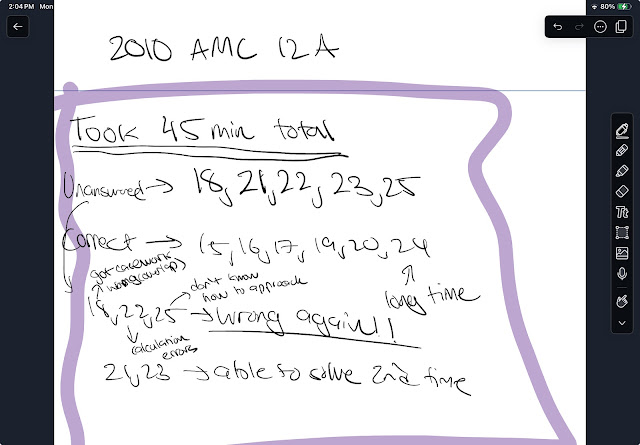
 6/17/2025 2010 AMC 12A


6/24/2025  
2010 AMC 12 B 


Friday, June 20, 2025

An, a 7th grader sample student reflection note, or report

from a 7th grader  A. 

2025 chapter test 

total 34 correct
21-30 wrong on sprint

8th was wrong on target
Sent from my iPhone

2024 chapter test
Sprint Round
2 Q19 Algebra Silly mistake Didn't set up the equation correctly Underline important parts of the question
3 Q23 Geometry Didn't know how to do it Learn how to do it
4 Q25 Geometry Didn't know how to do it Learn how to do it
5 Q26 Algebra Didn't know how to do it Learn how to do it
6 Q27 Time, Rate, Distance Didn't know how to do it Learn how to do it
7 Q28 Number Theory Didn't know how to do it Learn how to do it
8 Q29 Probability Silly mistake Didn't count all possible scenarios Learn how to do a faster way to solve these probability problems
9 Q30 Geometry Didn't know how to do it Learn how to do it
10 Target
11 Q5 Alegbra Wasn't sure on how to do it. Learn how to do it
12 Q6 Number Theory Didn't know how to do it Learn how to do it
13 Q8 Number Theory Wasn't sure on how to do it. Learn how to do it
14
15 Total score: 32

Sent from my iPhone


June 3, 2025 

2023 chapter

Sprint

Q20 time understood question but couldn't think of a solution learn how to do it Total score: 33

Q26 radicals calculation error I made a calculation error either adding or converting the radicals double check the calculation

Q27 3-D Geometry didn't know how to do it. learn how to do it
  1. Q28 counting didn't know how to do it. learn how to do it
    Q30 probability didn't know how to do it. learn how to do it
    Target
    Q4 geometry had an idea but it did not work learn how to do it
    Q6 probability didn't know how to do it learn how to do it
    Q7 2-D+3-D geometry had an idea but it did not work learn how to do it
    Q8 probability had an idea but it did not work learn how to do it
    Team
    Q4 combinatorics didn't know how to do it learn how to do it
    Q7 counting and geometry didn't know how to do it learn how to do it
    Q8 geometry didn't know how to create a picture that suits this problem learn how to do use imagination to help create a picture that suits this problem
    Q9 probability had an idea but it did not work learn how to do it
    Q10 counting silly mistake didn't read the question right underline important phrases

  2.   June 29, 2025

  3. 2021 state sprint
    20/30

    Q14 Probability silly mistake I included one but I wasn't supposed to When it says inclusive only count the highest number from 1 to H.
    Q18 Geometry silly mistake Instead of 6^2 I put 4^2 which messed up the answer First always label the given side lengths then find the unknown side lengths
    Q19 Number theory had the right number but my thought process wasn't right For these type of problems first find the number by subtracting the remainder then find the number of divisors then subtract by the amount of the divisors that cannot have that remainder and that is your answer
    Q22 Algebra didn't know how to this problem Learn how to do this problem a fast way and accurate way
    Q24 Algebra didn't know how to this problem Learn how to do this problem a fast way and accurate way
    Q25 Probability Had an idea got close but it didn't work Learn how to do this problem a fast way and accurate way
    Q27 Number theory didn't know how to this problem Learn how to do this problem a fast way and accurate way
    Q28 Counting Had an idea but it didn't work Learn how to do this problem a fast way and accurate way
    Q29 geometry Had an idea got close but it didn't work Learn how to do this problem a fast way and accurate way
    Q30 Algebra didn't know how to this problem Learn how to do this problem a fast way and accurate way

Friday, June 6, 2025

2015 Mathcounts National sprint #22 level 1 +


2015 Mathcounts National sprint #22

If six people randomly sit down at a table with six chairs, and they do not notice that there are name tags marking assigned seats, what is the probability that exactly three of them sit in the seat he or she was assigned? Express your answer as a common fraction.


Try this yourself first (extremely), then scroll down for solutions.


Method 1-Elementary Counting

Choose the three people who sit correctly: \( \binom{6}{3}=20 \).
The remaining three must all sit incorrectly. A quick check (or listing) shows only two ways: \((A\,B\,C)\) or \((A\,C\,B)\).
Total favourable seatings \(=20\times2=40\); total seatings \(=6!\).
Therefore \( P=\dfrac{40}{720}=\boxed{\tfrac{1}{18}} \).

Method 2 – Derangement formula

Pick the three fixed seats: \( \binom{6}{3}=20 \). Derange the other three: \( !3 = 2 \).
Again \( 20\times2 = 40 \) good seatings, so \[ P \;=\; \frac{20\cdot!3}{6!} \;=\; \boxed{\tfrac{1}{18}} . \]

Derange the remaining 3 people. The number of derangements of 3 items is \[ D_3 \;=\; 3!\left(1 - \frac{1}{1!} + \frac{1}{2!} - \frac{1}{3!}\right) \;=\; 6\left(1 - 1 + \frac{1}{2} - \frac{1}{6}\right) \;=\; 2. \]

Wednesday, June 4, 2025

student learning log, a high school student I volunteer

each week a space 

SAT 14 #2 wrong , 15 #2 


SAT 16, #5, 6, wrong , 17, 3 and 6 


2 weeks later  

18, #5 and 5

19  vocab. words 11 - 20 


SAT practice test 8, later math don't know what to do 

2 weeks later 

20, #5, 21, #4


more than a month later 

22, #4 and 5 , 23, #4, 6, 8, 12


30, #5, 31, #9 

32, #4, 5, 33, 2, 9 

local math competition : 21-22  meet 1, # 1, 2, 3 right 


34, #4, 35, #6 and 8 

21-22 math competition meet 2, #1 and 3 , #2 almost 


36 #1,2,3  need to work on harder vocabulary words

37 # 6,9

Math 2021-22 meet 2 # 1 and 3 


5/6/25 This week for reading I did Crack Sat tests 38 and 39 and I only gave myself 15 minutes for each test to time myself. 

For test 38 the questions I got wrong were 1 and 11 and for test 39 the questions I got wrong were 2 and 5. 

Although I felt rushed I was able to complete the test while still comprehending everything so that’s good. 


For math this week I realized that I struggled a lot on the algebra 2 part of the (local math competition) tests so I decided that I should learn some of the curriculum. 


To learn the course I went on Khan academy and did 2 units of the course and I plan on continuing learning the course to help with (local math competition) problems in the future. Thank you.


AOPS videos


Monday, June 2, 2025

One interesting question that has nice solution : Beginning level


2010 Mathcounts Nationals sprint :

22. Side AB of regular hexagon ABCDEF is extended past B to point X such that AX = 3AB. Given that each side of the hexagon is 2 units long, what is the length of segment FX? Express your answer in simplest radical form.


Try this question first before you scroll down for the solution. 


Then when we draw line FX, and by the Pythagorean Theorem, we have \[ FX = \sqrt{(\sqrt{3})^2 + (1 + 2 + 4)^2} = \sqrt{3 + 49} = \boxed{2\sqrt{13}}. \]

Tuesday, May 27, 2025

2025 Mathcounts state sprint #22 problem and solution : level 1 +


2025 Mathcounts state sprint

#22: Let n be a positive integer less than or equal to 1000. If the last two digits of n are reversed, the resulting integer is exactly 85 percent of n. What is the sum of the possible values of n?


Try this question first. Then scroll down for solution. 


Let n be a positive integer less than or equal to 1000. If the last two digits of n are reversed, the resulting integer is exactly 85 percent of n. What is the sum of the possible values of n?

Let the original number be:

$$n = 100h + 10t + u$$

The number formed by swapping the tens and units digits is:

$$n' = 100h + 10u + t$$

According to the problem:

$$n' = \frac{17}{20}n$$

So \( n \) has to be divisible by 20 (make sure you know why). This implies:

$$u = 0, \quad t \text{ is even}$$

Let:

$$t = 2k, \quad 0 \leq k \leq 4$$

Then:

$$n = 100h + 10t = 100h + 20k$$ $$n' = 100h + t = 100h + 2k$$

Now compute the difference:

$$n - n' = 18k$$

Also, from the given:

$$n - n' = n - \frac{17}{20}n = \frac{3}{20}n$$

Equating both expressions:

$$18k = \frac{3}{20}n \Rightarrow n = 120k$$

Since \( k \neq 0 \), we get:

$$n = 120k$$

Valid values for \( k \in \{1, 2, 3, 4\} \), so the numbers are:

$$120, \quad 240, \quad 360, \quad 480$$

Their sum is:

$$120 + 240 + 360 + 480 = 120(1 + 2 + 3 + 4) = 120 \times 10 = \boxed{1200}$$

Sunday, May 25, 2025

V's record

 V's record 

weekly homework about 30 to 45 minutes 

extra videos, links optional 

First lesson:

2010 chapter sprint: 

Hi, I got a score of 22 and got questions 16, 22, 23, 24,25,27,29, and 30 wrong. 

I just guessed these questions because I didn't really find a way to do them.

Second meet: 

2011-12 Mathcounts handbook  (40 questions total) 

Warm Up 1: 8
Warm Up 2: 19,20
Warm Up 3: 32, 39 
Workout 1: 23, 24, 30

Third meet: 

2010 Mathcounts school test : 

Hi, I finished trying the Sprint and Target questions:
 these are the problems that I got wrong 
Sprint: I got 7/15 correct.
     15,16: Attempted but answer was wrong
     19,20,26,27,29: Didn't attempt
       30: Couldn't find a good method to do, but was able to solve it by listing out all the possibilities.
Target: I got 6/8 correct.
    The first 6 were relatively easy and I could find a clear way to do them
    The last 2, I couldn't find a way to approach the problem.

Fourth meet : 
2011 Mathcounts school test : last 15 sprint and last 4 target 

Sprint: Out of the last 15, 
I got 7 correct.
The questions that I got wrong were 20,21,22,24,27,28,29,30. 

I tried 21,22, and 27 but the answers were incorrect. I wasn't able to attempt the rest. 

Target: I got every question other than #5. 
However, questions 1 and 2, 
I got wrong at first, but when I retried them, 
I was able to get them. I read the problems wrong and didn't fully understand them the first time.


Fifth meet : review 

Sixth meet : 
2011 chapter 
Hi Mrs Lin! I was able to try both the target and the sprint round questions and here are my results:
Target: I missed 3 & 8, and I didn't attempt them.
Sprint: I got 17,21,23,24,25, 27,29,30.
I didn't attempt 27,29, and 30,

2012 Mathcounts school 
Hi Mrs Lin! I was able to finish both the chapter and target, and here are my results:
Target: I got 5,6,and 8 wrong. I didn't try any of them because I didn't know how to do them.
Sprint: I got 18,23,25,26, and 30

Apr. 30, 2023 
2012 Mathcounts chapter 
Hi Mrs. Lin! I hope your having a very good day and week! I tried both the target and the sprint. 
Target: I got only number 8 wrong, but I didn't know how to do it.
Sprint: I got number 22, 24, 26,28,29, and 30 wrong. I tried to do 22, but I got it wrong. The rest I didn't know how to do them..

May 7th, review 

May 13th, 2023 
2013 Mathcounts School 
Hi Mrs.Lin, I was able to try both the Target and the Sprint and here are my results!
Target (5/8) I got 6,7, and 8 wrong, however, I was able to figure out the answer to problem 6 when I reviewed it. 
Sprint: I got 30,29,28, and 24 wrong. 

May 20th, 2023
Hi Mrs Lin!
2013 Mathcounts Chapter 
I was able to try both the target and sprint round tests and here are my results:
Target: 6/8. I attempted the first 6 problems and got all of them right. I understood the problems fairly well and was able to do all of them on the first try.
sprint: I got 10/15 right. I got all problems I attempted right, and didn't attempt 30,28,25,24,21, and 19.

2014 Mathcounts school 
Hi Mrs Lin, I was able to finish both the target and the sprint, and here were my results!
Sprint: 22/30, I didn't get 18,19,24,25,26,28,29, and 30. I attempted number 18, but didn't get it.
Target: I got 5 out of 8 on the target, but after reviewing my answers, I was able to figure out number 5.

2015 Mathcounts school 
Hi Mrs Lin, I was able to try both the sprint and target. For the sprint, I got problems 20 and 27 wrong, and I didn't attempt any problems past 24 other than 27.
For my  Target I got numbers 6,7, and 8 wrong, and I didn't know how to approach any of them. 

Show Your Work, Or, How My Math Abilities Started to Decline

Show your work, or, how my math abilities started to decline

I think it's problematic the way schools teach Algebra. Those meaningless show-your-work approaches, without knowing what Algebra is truly about. The overuse of calculators and the piecemeal way of teaching without the unification of the math concepts are detrimental to our children's ability to think critically and logically.

Of course eventually, it would be beneficial to students if they show their work with the much more challenging word problems (harder Mathcounts state team round, counting and probability questions, etc...), but it's totally different from what some schools ask of our capable students.

How do you improve problem solving skills with tons of worksheets by going through 50 to 100 problems all look very much the same? It's called busy work. 

Quote:  "Insanity: doing the same thing over and over again and expecting different results."

Quotes from Richard Feynman, the famous late Nobel-laureate physicist. Feynman relates his cousin's unhappy experience with algebra:

My cousin at that time—who was three years older—was in high school and was having considerable difficulty with his algebra. I was allowed to sit in the corner while the tutor tried to teach my cousin algebra. I said to my cousin then, "What are you trying to do?" I hear him talking about x, you know."Well, you know, 2x + 7 is equal to 15," he said, "and I'm trying to figure out what x is," and I say, "You mean 4." He says, "Yeah, but you did it by arithmetic. You have to do it by algebra."And that's why my cousin was never able to do algebra, because he didn't understand how he was supposed to do it. I learned algebra, fortunately, by—not going to school—by knowing the whole idea was to find out what x was and it didn't make any difference how you did it. There's no such a thing as, you know, do it by arithmetic, or you do it by algebra. It was a false thing that they had invented in school, so that the children who have to study algebra can all pass it. They had invented a set of rules, which if you followed them without thinking, could produce the answer. Subtract 7 from both sides. If you have a multiplier, divide both sides by the multiplier. And so on. A series of steps by which you could get the answer if you didn't understand what you were trying to do.
So I was lucky.
I always learnt things by myself.