Hi, Thanks for visiting my blog.
E-mail me at thelinscorner@gmail.com if you want to learn with me. :) :) :)
Currently I'm running different levels of problem solving lessons, and it's lots of fun learning along with students from different states/countries.
So many students are not learning smart.
Problem solving is really fun (and a lot of the times very hard, yes).
Good questions are intriguing and delicious, so come join our vibrant community and have the pleasure of finding things out on your own.
There is no overnight success.
My other blogs :
thelinscorner : Standardized test preps (ONLY the hardest problems), books, links/videos for life-time learning
Take care and have fun learning.
Don't forget other equally interesting activities/contests, which engage your creativity and imagination.
Some also require team work. Go for those and have fun !!
Don't just do math.
Before going full throttle mode for competition math, please spend some time reading this
well- thought-out article from BOGTRO at AoPS
"Learn How to Learn".
It will save you tons of time and numerous, unnecessary hours without a clear goal, better method in mind.
Less is more. My best students make steady, very satisfactory progress in much less time than those
counterparts who spent double, triple, or even more multiple times of prep with little to show.
It's all about "deliberate practices", "tenacity", and most of all, "the pleasure of finding things out on your own".
Take care and have fun problem solving.
I have been coaching students for many years. By now, I know to achieve stellar performance you need :
Grit (from TED talk), not only that but self-awareness (so you can fairly evaluate your own progress) and a nurturing-caring environment. (Parents need to be engaged as well.)
Thanks a lot !! Mrs. Lin
"Work Smart !!" , "Deliberate practices that target your weakness ", " Relax and get fully rested.", "Pace your time well", "Every point is the same so let go of some questions first; you can always go back to them if time permits."
"It's tremendous efforts preparing for a major event on top of mounting homework and if you are the ones who want to try that, not your parents and you work diligently towards your goal, good for you !!"
"Have fun, Mathcounts changes lives, because at middle school level at least, it's one of those rare occasions that the challenges are hard, especially at the state and national level."
Now, here are the links to get you started:
Of course use my blog. Whenever I have time I analyze students' errors and try to find better ways (the most elegant solutions or the Harvey method I hope) to tackle a problem. Use the search button to help you target your weakness area.
Newest Mathcounts' competition problems and answer key
For state/national prep, find your weakness and work on the problems backwards, from the hardest to the easiest.
Here are some other links/sites that are
the best.
Mathcounts Mini : At the very least, finish watching and understanding most of the questions from 2010 till now and work on the follow-up sheets, since detailed solutions are provided along with some more challenging problems.
For those who are aiming for the state/national competition, you can skip the warm-up and go directly to "The Problems" used on the video as well as work on the harder problems afterward.
Art of Problem Solving
The best place to ask for help on challenging math problems.
Some of the best students/coaches/teachers are there to help you better your problem solving skills.
Do Not Rush !!
Awesome site!!
For concepts reviewing, try the following three links.
Mathcounts Toolbox
Coach Monks's Mathcounts Playbook
You really need to understand how each concept works for the review sheets to be useful.
To my exasperation, I have kids who mix up the formulas without gaining a true understanding and appreciation of how an elegant, seemingly simple formula can answer myriads of questions.
You don't need a lot of formulas, handbook questions, or test questions to excel.
You simply need to know how the concepts work and apply that knowledge to different problems/situations.
Hope this is helpful!!

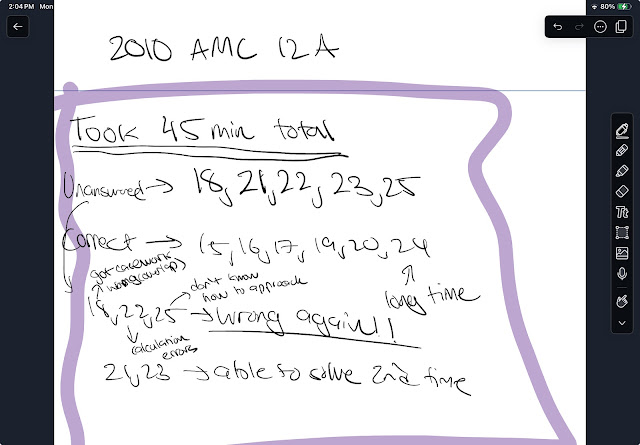



Q28 counting didn't know how to do it. learn how to do it
Q30 probability didn't know how to do it. learn how to do it
Target
Q4 geometry had an idea but it did not work learn how to do it
Q6 probability didn't know how to do it learn how to do it
Q7 2-D+3-D geometry had an idea but it did not work learn how to do it
Q8 probability had an idea but it did not work learn how to do it
Team
Q4 combinatorics didn't know how to do it learn how to do it
Q7 counting and geometry didn't know how to do it learn how to do it
Q8 geometry didn't know how to create a picture that suits this problem learn how to do use imagination to help create a picture that suits this problem
Q9 probability had an idea but it did not work learn how to do it
Q10 counting silly mistake didn't read the question right underline important phrases